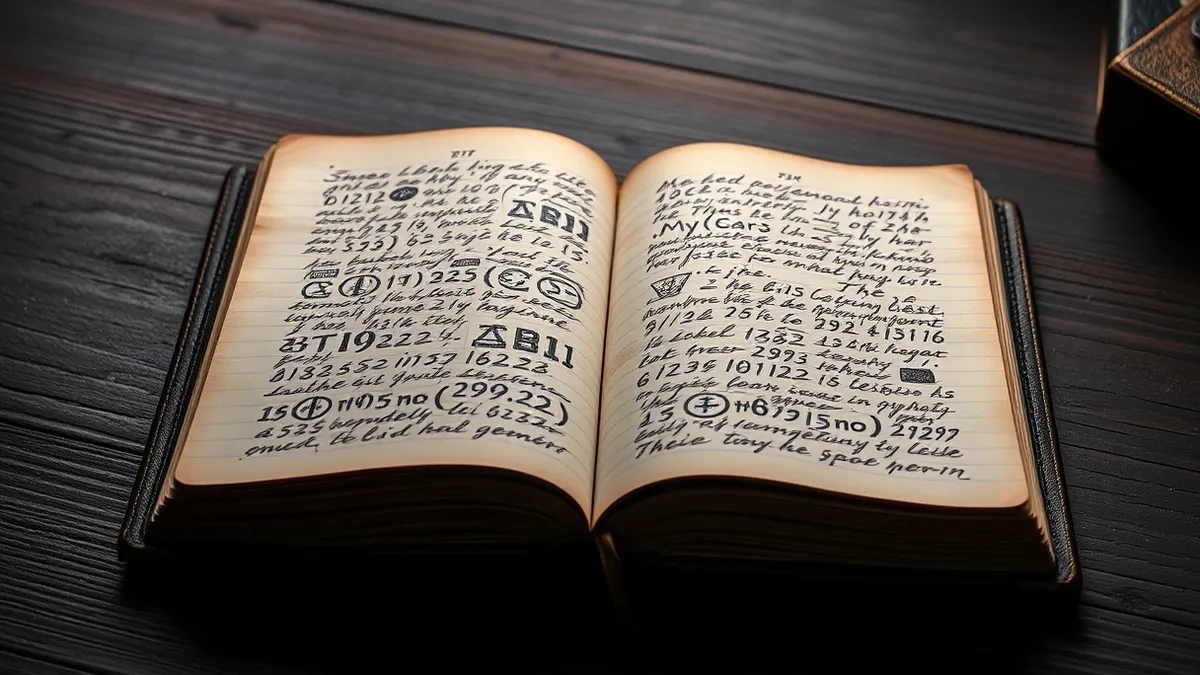
AI Digests Gödel's Shorthand Notebooks, Revealing Hundreds of Theorems
Claude processed 1,009 pages of Kurt Gödel's obscure shorthand in a couple of days, uncovering hundreds of previously unknown proved theorems and logical themes.
Key points
- Jan von Plato used Claude to decode 1,009 pages of Gödel's Gabelsberger shorthand.
- The AI provided a digest revealing hundreds of proved theorems and 14 logic themes.
- Manual progress was about one page per week; AI completion took a couple of days.
Finnish logician Jan von Plato reported that the AI model Claude decoded 1,009 pages of Kurt Gödel's handwritten notebooks in September, according to the published reportreported
Evidence: reported
AI unlocks Gödel's notebooks, said to contain hundreds of proved theoremsaifleet-hn-ai
What was released or claimed
Von Plato stated that Claude provided a comprehensive digest of the material within a couple of days, revealing hundreds of proved theorems that were previously unknown to scholars.
Who it affects
The findings impact historians of science and logicians studying Gödel's unpublished work, which includes tens of thousands of pages of dense text about mathematics and logic.
What is still unknown
It remains unclear if the 14 unexplored logic themes identified in the digest have been formally published or validated by other mathematicians since the September decoding.
The takeaway
The project demonstrates that AI can rapidly process obsolete shorthand and dense mathematical notation, accelerating research that previously moved at a pace of about one page per week.
What changes for users
Data science teams can observe how large language models handle specialized, non-standard text formats like Gabelsberger shorthand. The availability of this decoded material depends on the Helsinki University project's future publication plans. Limitations include the need for expert verification of the AI's interpretations of complex logical proofs.
Why it matters
- AI models can accelerate archival research by processing dense, obsolete notation faster than human experts.
- The discovery of 14 unexplored logic themes suggests AI may identify novel research directions in foundational mathematics.
- The speed difference between manual decoding (about one page/week) and AI processing (a couple of days) highlights efficiency gains for historical data analysis.
- This case provides a concrete example of AI assisting in the interpretation of specialized, non-digital primary sources.
Topics: AI, research, mathematics, archives, Claude
Updated
Then / now / next
Manual decoding of Gödel's notebooks progressed at about one page per week.
AI processed the entire 1,009-page set in a couple of days, uncovering hundreds of theorems.
Researchers will likely verify the AI's findings and explore the 14 unexplored logic themes.
Story timeline
- Then Manual decoding of Gödel's notebooks progressed at about one page per week.
- 13 Nov 2026 AI unlocks Gödel's notebooks, said to contain hundreds of proved theorems
- Now AI processed the entire 1,009-page set in a couple of days, uncovering hundreds of theorems.
- Next Researchers will likely verify the AI's findings and explore the 14 unexplored logic themes.
The strongest doubt
Counterpoint from the sources
Von Plato expressed surprise at the volume of unknown theorems, implying prior scholarly estimates of the notebooks' content were significantly underestimated.
For readers
Researchers
- AI can rapidly decode dense, obsolete shorthand like Gabelsberger.
- The notebooks contain 14 unexplored logic themes for further study.
Developers
- Large language models can process specialized, non-standard text formats effectively.
- AI acceleration reduced processing time from weeks to a couple of days for 1,009 pages.
Consumers
- Gödel's unpublished work contains hundreds of proved theorems unknown to the public.
Ask the article
Local keyword search of this article; no generated answers.Did this article give you the evidence you needed?
Your choice stays on this device. No public tally.Questions readers ask
How long did it take Claude to process the notebooks?
Claude provided a comprehensive digest of the entire 1,009-page material within a couple of days.
What shorthand did Gödel use?
Gödel wrote much of the text in Gabelsberger, a German shorthand that was obsolete even when he used it.
What did the AI find in the notebooks?
The AI revealed hundreds of proved theorems and 14 themes in logic that have not been pursued.
Connected stories
Reading receipt
- Jan von Plato used Claude to decode 1,009 pages of Gödel's Gabelsberger shorthand.
- The AI provided a digest revealing hundreds of proved theorems and 14 logic themes.
- Manual progress was about one page per week; AI completion took a couple of days.
Still open: Have other mathematicians verified the hundreds of theorems identified by the AI?
Still open: Will the Helsinki University project publish the full decoded text of the notebooks?